PUBLISHED BOOK
About this publication and how it works
How Blackland Chronology works: its beat, its editorial method, the records it reads, and the readers it serves across Denton County.
Filed 8 min readBy the Blackland Chronology editorial team
This publication says what it does not know. When a figure is missing from the page it checked, it names the page and leaves the figure out rather than filling it in.
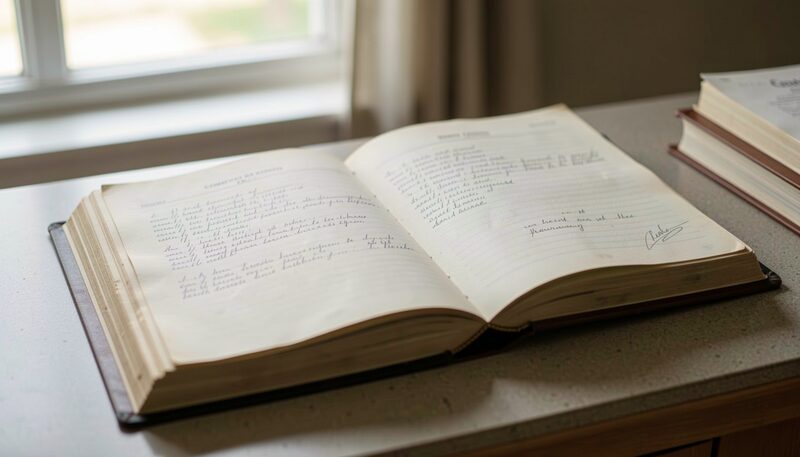
This publication is a magazine about Denton County, Texas, and about the paper trail its families left behind. If you have ever wondered what kind of reading goes into a county history article, how a date gets checked against three disagreeing documents, or who the writing is aimed at, this page answers those questions in the order they come up.
Blackland Chronology is an English-language magazine on Denton County history: the county seat and its courthouse square, the towns and rural communities of the Blackland Prairie and the Cross Timbers, and the farm, ranch, school, church and business life that filled them from the pioneer era onward. It is written about places, records and people. It is not a museum, not a historical association and not a county body, and it holds no collection of its own.
What subjects the magazine takes on
The range is set by the county itself. A single issue might move from a square in Denton to a crossroads community that no longer appears on a road map, and from there to a school district consolidation or the closing of a cotton gin. county history coverage follows the county seat and its courthouse square as closely as it follows the small towns and rural communities around them. Farm and ranch life gets the same attention as business life, because in a Blackland Prairie county the two are hard to separate. Churches, schools and the people who kept them running show up repeatedly, not as background but as the institutions that generated most of the records a family historian will eventually read. The magazine treats the archival record itself as a subject, which means an article about a cemetery can be as much about how the stones were surveyed as about who is buried there.
The editorial method, described plainly
The Blackland Chronology editorial method starts with the record type and works outward. Before any narrative is written, the editor identifies what kind of document carries the fact in question: a deed, a probate file, a census schedule, a cemetery survey, a newspaper notice, a photograph, or a Texas Historical Commission marker file. Each type has its own habits and its own failure modes, and knowing which one you are reading changes what you can safely claim. A deed tells you who transferred land and when the instrument was filed. It rarely tells you who lived on the land, and it never tells you why a family moved. Those distinctions are stated in the article rather than smoothed over.
Readers who want the underlying records rather than the articles built from them can go straight to Denton County primary sources, where digitized newspapers, photographs, maps and documents are held and searchable by collection, partner, location, subject, resource type and date.
The magazine draws on records and research rather than on memory or local tradition alone. That is a deliberate restriction. Family stories are often the reason an article gets written, but they are not evidence, and the magazine says so when a story cannot be corroborated. When a claim rests on one document only, the article says that too.
How a date gets checked
Dates are where county records disagree most often, and the disagreements are usually explainable. A family may appear in a census with an age that shifts by two years between enumerations. A death certificate may give a birth year that conflicts with a gravestone. A newspaper may report a marriage in the week it was announced rather than the week it occurred. None of these is necessarily an error; each reflects who was answering the question and when.
Where two records conflict, the magazine weighs them rather than picking a winner silently. census and cemetery evidence is compared against the paper trail, and the article states which record was preferred and why. If the conflict cannot be resolved, the article says the conflict exists. That is more useful to a genealogist than a confident date with no reasoning behind it, because it tells the reader where to look next.
Who the magazine is written for
The first audience is family historians and genealogists with Denton County roots, including those researching from outside Texas who may never have set foot in the county. The second is residents and newcomers who want to understand the place they now live in. The third is Texas history teachers and their students, who need county-level examples that connect to a broader state story. The fourth is readers of county and local history across North Texas, who may have no Denton County ancestors at all but recognize the patterns.
Those four audiences want different things, and the writing tries to serve all of them without talking down to any. A genealogist needs the record citation. A newcomer needs the geography explained. A teacher needs a sequence of events that holds together. Keeping all three in view is what forces the method to stay explicit: when the reasoning is visible on the page, every reader can judge it for themselves.
What the magazine does not provide
It does not hold a collection, and it does not offer a research, reproduction or search service. If you write asking for a lookup, the answer will be that the magazine has nothing to look up in. It sells no artefact, no print and no image licence. It does not run a surname registry and does not put researchers in touch with one another. Where an article points at a holding institution, that institution is named, and the reader deals with it directly.
Does the magazine publish everything it finds?
No. Two limits are worth stating. The first is that the magazine reports on records rather than transcribing them in full. A deed abstract in an article is a summary of the instrument, not a substitute for it, and anyone needing the exact wording has to go to the volume. The second is that nothing is published about living people beyond what a public record already carries. That rule occasionally means a family history stops earlier than a reader would like.
A third limit is simpler: the magazine covers Denton County. Neighbouring counties appear when they explain something inside the county line, not on their own account.
Why local history publishing works this way
County history writing is slow by nature, and the reason is structural. The records are scattered across courthouse volumes, library holdings, cemetery associations and private collections, and no single index covers all of them. Local History Publishing Is the kind of work that depends on a small number of people reading carefully for a long time rather than on a large operation moving quickly.
That constraint shapes the output. Articles tend to be narrow and specific: one family, one building, one institution, one record set. Narrow articles age better, because a claim about a single probate file is easier to verify and correct than a sweeping claim about a whole decade. When a reader finds an error, the correction can be made in a way that helps the next person.
Responding to the method
The method is meant to be argued with. If you think a document was misread, a date preferred wrongly, or a record type given more weight than it deserves, you may contact the editors. Corrections that come with a citation are the most useful, because the point of the exercise is to get closer to what the records actually say, not to defend an earlier draft. Readers who have a document the magazine has not seen are in a position to improve an article rather than merely dispute it.
Start with the record you already have in hand, note what it does and does not say, and see where the citation leads.
About the portal cited above. The Portal to Texas History is a gateway to rare, historical, and primary source materials from or about Texas. Its holdings are organised into resource types including newspapers, photographs, maps, books, letters, legal and legislative documents, yearbooks, postcards, pamphlets and theses, and it can be explored by collection, by partner, by location, by subject, by resource type, by date and by publication title. It offers guided, advanced and proximity search alongside its standard search, and states its purpose as educating, preserving and building connections across the state, with a programme of Texas history resources for teachers mapped to the Texas Essential Knowledge and Skills standards.
The Blackland Chronology editorial team / contact@dentoncountyhistoricalmuseum.com

What this entry rests on
- UndatedPUBLISHED BOOKWhat subjects the magazine takes on
- UndatedCENSUSThe editorial method, described plainly
- UndatedDEEDHow a date gets checked
Corrections to this entry
- : first publication, no correction recorded yet.